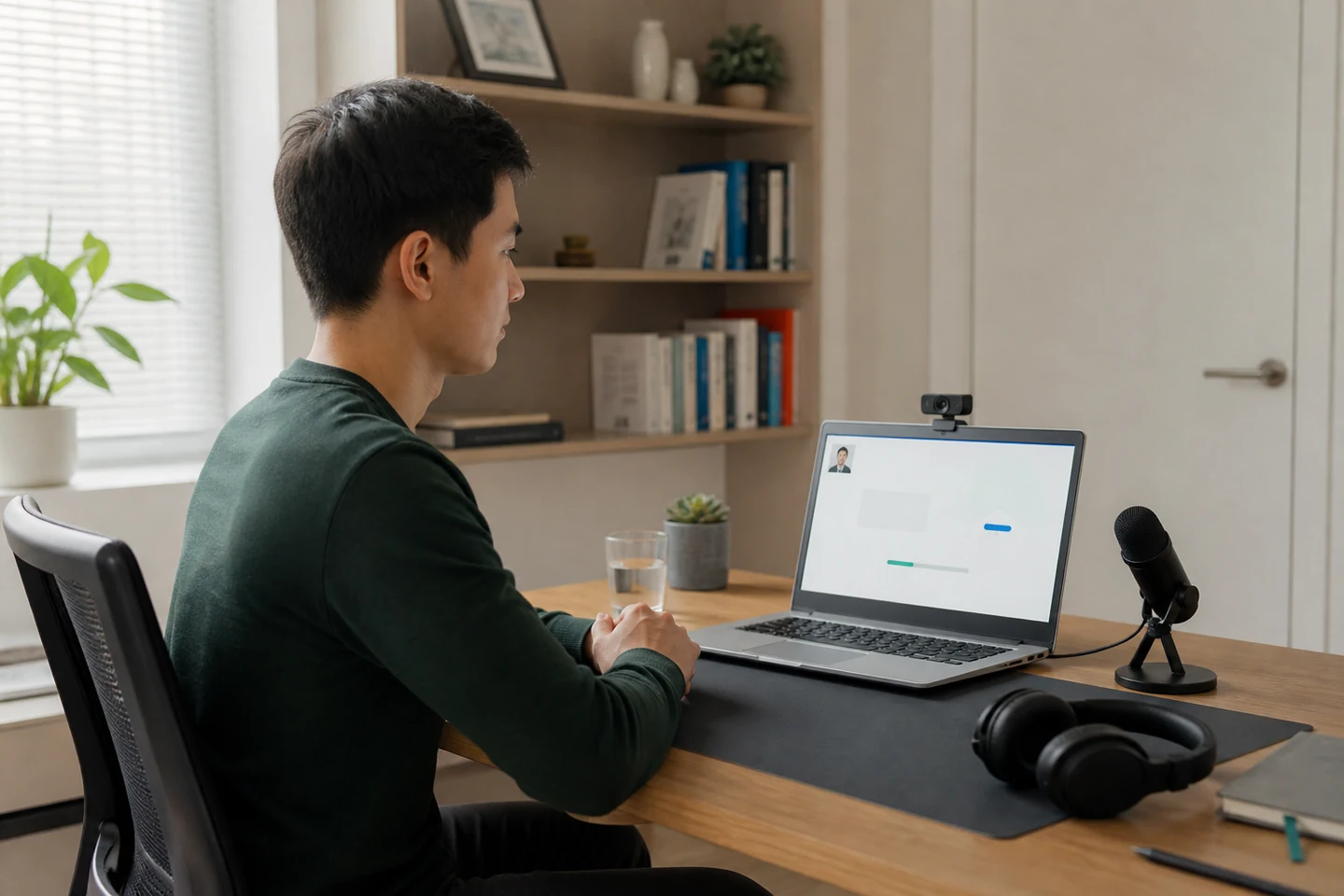
Free English speaking practice online (no teacher needed)
IELTS specialists — MUIC & Chulalongkorn University alumni, IELTS Speaking Band 9, trained via IDP IELTS teacher courses.

Yes — you can improve your spoken English for free, online, without a teacher. The one rule that matters is that you must actually speak out loud every day, not just read or listen. The fastest free routine is: (1) play a talk-to-progress speaking game that only advances when you speak, (2) shadow short clips by reading or repeating them aloud, and (3) record yourself for one minute, then listen back and fix one thing. Do about 10–15 minutes a day and you will hear real gains in a few weeks. You can start right now, free, with the speaking game at engforedu.com/pine-speak.
You can practise speaking on your own — here's why
Speaking feels like the one skill you need a partner for, but it is actually the easiest to train alone. Your mouth, not your grammar book, is the muscle that gets you fluent, and you can exercise it in any quiet room. What you cannot do alone is fake it: reading English, watching series, and learning word lists build knowledge, but they never make you fluent, because none of them make you produce speech under a little pressure.
The learners who improve fastest without a teacher all do the same thing — they talk out loud every single day, even for a few minutes, and they get some kind of feedback on it. Everything below is a free way to do exactly that.

The real problem: you have to speak, not study
Most people 'practise speaking' by silently studying and never opening their mouth. Then the words won't come out on the day it counts. Fluency is the ability to retrieve and pronounce words fast enough to keep going, and that only develops when you rehearse the act of speaking itself.
So the goal of a free routine is simple: maximise the number of minutes your voice is actually producing English. A tool that forces you to speak beats a tool you can passively scroll.
Free method 1 — a talk-to-progress speaking game
The single best free tool for solo practice is a speaking game that only moves forward when you speak. Because the story won't continue until you say the line or answer the prompt, you can't quietly skip the hard part — the part that actually makes you fluent.
engforedu.com/pine-speak is a free branching speaking game built exactly for this. You read lines aloud, repeat them, and take longer speaking turns to move the story on, across levels from beginner (A1) to advanced (C2). It even has an 'Exam speaking' genre with prompts modelled on IELTS, PTE and Duolingo-style speaking tasks, so the same daily habit doubles as test practice. It is the lowest-friction way to get your voice producing English every day — open it and talk.
Free method 2 — shadowing and reading aloud
Shadowing means playing a short clip of natural English and speaking along with it — copying the rhythm, stress and intonation, not just the words. It trains pronunciation and flow at the same time, and it is completely free with any video or podcast you like.
Reading aloud is the simpler cousin: take any paragraph and read it out clearly, then read it again faster and smoother. Both drills turn 'input' into 'output' and get your mouth used to the shapes of English.
- Pick a 30–60 second clip of clear speech you enjoy.
- Listen once, then play it again and speak along, matching the speaker.
- Repeat the same clip 3–4 times until it feels smooth — mastery beats variety here.
Free method 3 — record, listen back, fix one thing
Your phone's voice recorder is a free coach. Answer a question (What did you do yesterday? Describe your hometown.) for one minute, then listen back. You will instantly hear the fillers, the pauses and the sounds that need work — things you never notice while speaking.
The trick is to fix just one thing per recording: slow down, or stop saying 'ehh', or nail one tricky word. Small, repeated corrections compound far faster than trying to fix everything at once.
Build a 15-minute daily speaking habit
Consistency beats intensity. A short daily session keeps your speaking 'warm' and builds the automatic recall that fluency depends on. A workable free routine looks like this — and you can do the whole thing on engforedu.com for free.
- 5 min: a few rounds of the speaking game at engforedu.com/pine-speak to warm up your voice.
- 5 min: shadow one short clip until it's smooth.
- 5 min: record a one-minute answer to a question, listen back, fix one thing.
- Once a week: try a longer speaking turn or an exam-style prompt to stretch yourself.
Getting feedback without a tutor
The one thing a teacher gives you is feedback, and you can get a lot of it free. Recording yourself is self-feedback; a speaking game gives you instant right/wrong on read-aloud and repetition; and AI scoring can mark a spoken answer against clear criteria and tell you what to fix.
When you want to turn this daily speaking habit into real exam readiness, engforedu.com/journey gives you free practice across all four skills with instant, bilingual feedback — so you can see your level and aim your effort where it moves the needle. Start free, keep it daily, and let the feedback loop do the work.
How to practise English speaking free, on your own
- 1Commit to speaking out loud daily
Decide that every session includes your voice producing English — no silent study counts.
- 2Warm up with a speaking game
Play a talk-to-progress game like engforedu.com/pine-speak so you can't skip actually speaking.
- 3Shadow a short clip
Speak along with 30–60 seconds of natural English, copying rhythm and stress.
- 4Record and review
Answer a question for one minute, listen back, and fix exactly one thing.
- 5Keep it short and daily
Aim for 10–15 focused minutes a day rather than one long weekend session.
- 6Add feedback
Use instant game feedback and free AI-scored practice at engforedu.com/journey to target your weak points.
Frequently asked questions
Can I really improve my English speaking without a teacher?
Yes. The key is speaking out loud every day and getting feedback — from self-recordings, a speaking game's instant checks, or AI scoring. A teacher speeds up nuance, but the core work is daily speaking practice you can do alone for free.
What is the best free way to practise speaking English?
A talk-to-progress speaking game is the most reliable, because it forces you to actually speak to continue. Pair it with shadowing and one-minute self-recordings. You can start free at engforedu.com/pine-speak.
How long should I practise speaking each day?
About 10–15 focused minutes daily beats a single long session. Consistency builds the fast word-recall that fluency depends on.
How do I practise speaking if I have no one to talk to?
You don't need a partner. Speak to a game, shadow clips, describe your day out loud, and record yourself. All of these get your voice producing English, which is what actually builds fluency.
Does shadowing really improve pronunciation?
Yes — copying a native clip's rhythm, stress and intonation trains pronunciation and flow together. Repeat the same short clip several times rather than switching clips constantly.
How will I know if I'm getting better?
Record the same one-minute answer each week and compare: fewer pauses, fewer fillers and clearer sounds are real progress. Free AI-scored practice at engforedu.com/journey also tracks your level over time.
Turn the guide into a concrete study plan with free practice, mock tasks and instant feedback.
Trusted by 3,000+ students nationwide · free to start, no card needed