
How to write an English resume/CV that gets interviews
IELTS specialists — MUIC & Chulalongkorn University alumni, IELTS Speaking Band 9, trained via IDP IELTS teacher courses.

A strong English CV is one page (two at most), easy to skim, and written in bullet points that start with an action verb and end with a result — ideally a number. Lead with a two-line professional summary, then list experience newest-first, mirror the exact keywords from the job advert, and keep formatting clean and consistent. Save it as a PDF named 'Firstname-Lastname-CV.pdf', and proofread every line, because typos and vague duties ('responsible for…') are what get applicants filtered out. Sharpen the English you'll also need in the interview and on the job with free practice at engforedu.com/journey.
What a recruiter actually does with your CV
A recruiter spends only a few seconds on the first pass, and many companies filter CVs with software before a human sees them. That changes how you should write: your CV has to be instantly skimmable and use the same words as the job advert, or it gets skipped — no matter how good you are.
So the goal isn't to say everything about you. It's to make the right things impossible to miss: the role you want, the results you've delivered, and the skills the advert asked for.
The structure that works
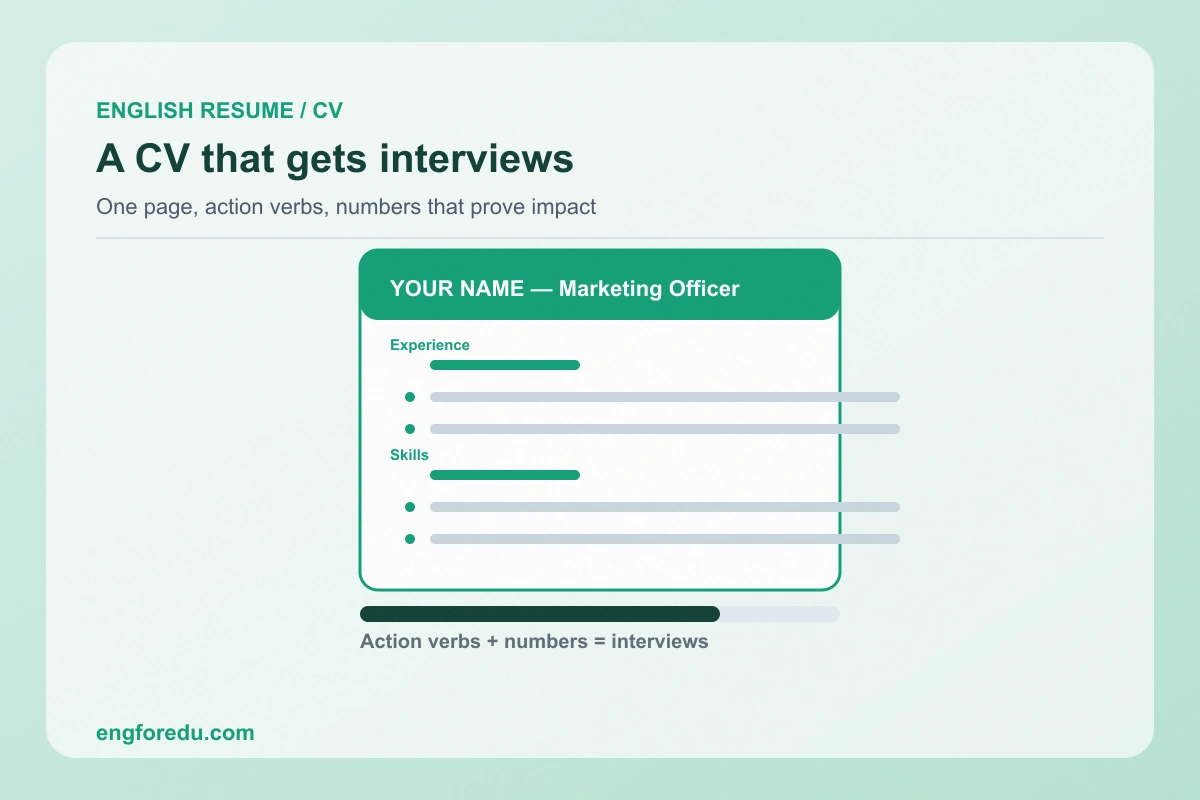
- Header: name, job title you're targeting, phone, professional email, city, and a LinkedIn URL. No photo or ID numbers needed for most international roles.
- Professional summary: two lines saying who you are, your strongest skills, and what you're aiming for.
- Work experience: newest first — job title, company, dates, then 3–5 bullet points of achievements.
- Education: degree, institution, year. Add GPA or honours only if strong.
- Skills: tools, languages (with level), and an English test score if you have one, e.g. 'TOEIC 780'.
Write bullets that start with a verb and end with a result
The single biggest upgrade is turning duties into achievements. Don't write 'Responsible for social media.' Write 'Grew the company's Facebook following by 45% in six months by posting daily and running two campaigns.' Start with an action verb, say what you did, and finish with a result.
Strong action verbs: led, built, launched, improved, reduced, increased, managed, designed, negotiated, delivered. Numbers make results believable — percentages, amounts, time saved, people managed. Even rough figures ('handled ~40 customer calls a day') beat none.
Match the keywords in the job advert
Read the advert and note the exact skills and tools it names, then make sure the same words appear naturally in your CV (only if they're true). If the ad says 'inventory management' and you wrote 'stock control', switch to their wording. This helps both the filtering software and the human who reads next.
Tailor the top third of your CV — the summary and your most recent role — to each application. You don't need to rewrite the whole thing, just align the parts a recruiter reads first.
Get the English right
Small English errors on a CV stand out because the document is short and every line is read. Use past tense for previous jobs and present tense for your current one, keep bullet points parallel (all starting with a verb), and stay consistent with spelling (British or American, not both).
Proofread out loud, then have someone else check it — or paste a sentence into a tool that explains the fix, so you learn it. The same clear, professional English you need on the CV is what you'll need in the interview and the job itself, so it's worth building properly with free all-skills practice and AI feedback at engforedu.com/journey.
Mistakes that get CVs rejected
- Longer than two pages, or a wall of text with no bullet points.
- Vague duties ('responsible for…') instead of achievements with results.
- Typos, mixed tenses, or an unprofessional email address.
- A generic CV sent to every job with no tailoring to the advert.
- Saving as an editable file with a messy name — export a clean PDF named 'Firstname-Lastname-CV.pdf'.
How to write an English CV that gets interviews
- 1Start from the job advert
List the skills, tools and keywords the employer asks for so you can mirror them.
- 2Write a two-line summary
Say who you are, your strongest skills, and the role you're targeting.
- 3Turn duties into achievements
Rewrite each bullet to start with an action verb and end with a result or number.
- 4Match their keywords
Use the advert's exact wording for skills you genuinely have, especially in the top third.
- 5Proofread the English
Check tenses, parallel bullets and spelling; read it aloud and have someone review it.
- 6Export a clean PDF
Save as 'Firstname-Lastname-CV.pdf' with simple, consistent formatting.
Frequently asked questions
How long should an English CV be?
One page for most people, two at most for senior roles. Recruiters skim, so keep it tight and use bullet points rather than paragraphs.
What's the difference between a resume and a CV?
In much of Asia and Europe the words are used interchangeably for a short 1–2 page job document. (A true academic 'CV' in the US/UK sense is a long research record — that's not what most job applications want.)
Should I put a photo on my CV?
For most international and English-language applications, no — skills and results matter more, and many recruiters prefer no photo. Follow local norms if a specific employer asks for one.
Should I include my TOEIC or IELTS score?
Yes, if it's relevant and reasonably strong — an English test score like 'TOEIC 780' is concrete proof of your level and can help you pass filters for roles that need English.
How do I make my experience sound impressive without lying?
Use real numbers and action verbs. Quantify what you actually did — customers handled, time saved, growth achieved — and choose strong verbs like led, built and improved. You don't need to exaggerate; specifics are what convince.
Turn the guide into a concrete study plan with free practice, mock tasks and instant feedback.
Trusted by 3,000+ students nationwide · free to start, no card needed